A failed rooftop unit rarely announces itself at a convenient time. It shows up as a warm office on a Monday morning, an uncomfortable retail floor during a busy weekend, or tenant complaints after the first cold Bay Area evening. The best commercial HVAC maintenance practices are designed to prevent those disruptions before they affect your people, customers, equipment, and operating budget.
For property managers and business owners, maintenance is not simply a box to check. It is a practical way to extend equipment life, control utility costs, support indoor air quality, and make repair decisions before an urgent breakdown limits your options.
Best Commercial HVAC Maintenance Practices for Reliable Operation
The most effective maintenance plans are consistent, documented, and tailored to the building. A small professional office with a single split system has very different needs from a restaurant, medical office, multi-tenant retail property, or large warehouse with multiple rooftop units.
Still, every commercial property benefits from a scheduled inspection program rather than waiting for a comfort complaint. In most Bay Area buildings, service should occur at least twice a year: once before cooling demand rises and again before the heating season. Buildings with heavy occupancy, extended hours, commercial kitchens, sensitive equipment, or high indoor air quality requirements may need more frequent visits.
A qualified technician should evaluate the system as a whole, not just respond to the part that has failed. That means checking airflow, electrical components, refrigerant performance, drainage, thermostat operation, filters, belts, motors, coils, safety controls, and the condition of accessible ductwork. Small issues in any one of these areas can force the rest of the system to work harder.
Start with a clear equipment inventory
Commercial maintenance is easier to manage when every major component is identified. Keep a current record of each unit’s make, model, age, location, capacity, warranty status, filter size, and service history. For rooftop equipment, note roof access requirements and any tenant areas served by each unit.
This record helps a technician diagnose recurring concerns and helps managers plan ahead. If the same unit has needed multiple compressor-related repairs, for example, its history provides useful context for deciding whether another repair makes financial sense. It also prevents a common problem in larger properties: servicing the most visible equipment while an older, less-accessible unit quietly deteriorates.
Replace filters based on conditions, not guesswork
Dirty filters restrict airflow, reduce comfort, and can contribute to frozen coils, blower strain, and rising energy use. Yet a fixed filter schedule is not always enough. A building near heavy traffic, an occupied retail location, a pet-friendly office, or a facility with renovation activity can load filters far faster than a low-traffic office.
Check filters monthly and replace them according to their condition and the manufacturer’s requirements. Select the filter rating carefully. Higher-efficiency filters can capture more particles, but a system that was not designed for them may suffer from restricted airflow. A commercial HVAC professional can confirm the right filter type for your equipment and indoor air quality goals.
Keep coils, drains, and outdoor sections clean
Evaporator and condenser coils transfer heat. When dust, pollen, grease, or debris coats them, the system must run longer to do the same job. This reduces efficiency and increases wear on major components.
Outdoor condensers and rooftop units also need clear space around them. Leaves, packaging, nesting materials, and stored items can block airflow. On a roof, windblown debris may be easy to overlook until it contributes to an overheating unit. Indoor condensate drains deserve the same attention. A blocked drain can cause water damage, trigger safety shutoffs, or create moisture concerns around ceiling spaces and air handlers.
Protect Airflow Before It Becomes a Comfort Complaint
When one suite is too warm and another is too cold, the thermostat is often blamed first. In commercial buildings, the real cause may be airflow imbalance, a failing blower motor, leaking ductwork, a stuck damper, or a return-air restriction.
Routine maintenance should include checking supply and return airflow, listening for unusual blower noise, inspecting accessible duct connections, and verifying that vents are open and unobstructed. Furniture changes, tenant improvements, and office reconfigurations can all interfere with air distribution over time.
Ventilation also matters. Outdoor air requirements vary by building use, occupancy, and local code. Bringing in too little outside air can affect indoor air quality, while bringing in too much untreated outside air can drive up heating and cooling loads. The right balance depends on the building and its equipment, which is why a one-size-fits-all adjustment is rarely the right answer.
Verify thermostats, controls, and schedules
A well-maintained HVAC unit can still waste energy if it is running on the wrong schedule. Review thermostat settings, building automation controls, occupancy schedules, and setback temperatures at least seasonally. Confirm that separate zones are responding correctly and that thermostats are not exposed to direct sunlight, equipment heat, or drafts.
Modern programmable and smart thermostat controls can improve visibility and reduce unnecessary runtime. However, they need to be configured around actual operating hours. A building that hosts evening meetings, weekend tenants, or variable staffing may need schedule adjustments that a standard weekday program will not handle well.
Address Electrical and Mechanical Wear Early
Commercial HVAC equipment relies on electrical connections, capacitors, contactors, motors, belts, bearings, and safety controls that wear gradually. A loose electrical connection or deteriorated belt may not stop the system immediately, but it can lead to a costly failure during peak demand.
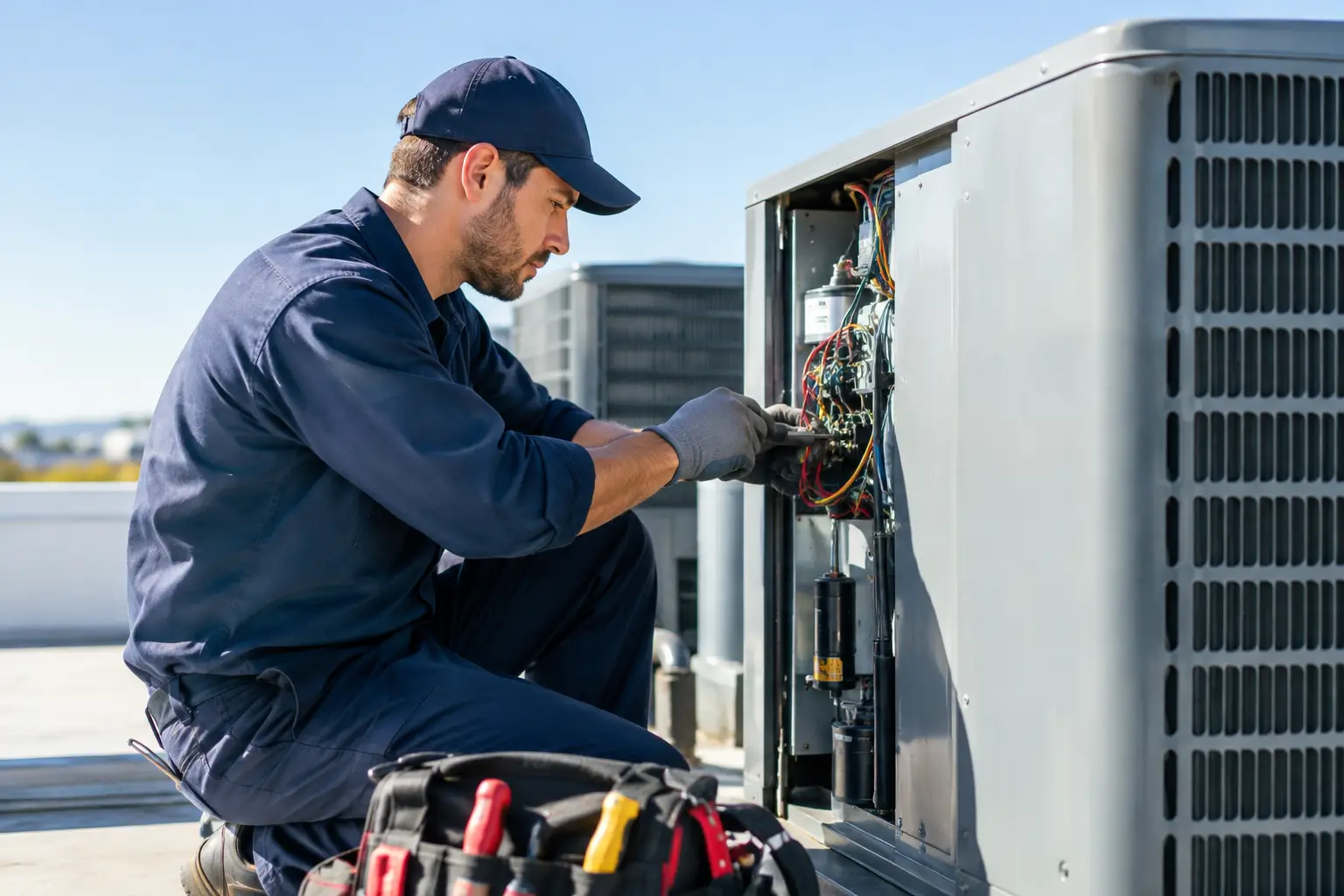
During preventive service, technicians should test electrical components, inspect wiring, measure motor performance, check belt tension and alignment where applicable, and look for vibration or excessive noise. Refrigerant readings should also be evaluated when performance suggests a problem. Refrigerant is not something that is routinely “used up.” Low levels can point to a leak that should be located and repaired rather than repeatedly topped off.
This is where documented maintenance pays off. Trend information, such as repeated high amperage, recurring drain issues, or declining cooling performance, can reveal a developing problem before it becomes an emergency call.
Plan Repairs and Replacements Around the Building’s Needs
Not every aging commercial unit should be replaced, and not every repair is worth approving. The right decision depends on the equipment’s age, repair history, efficiency, condition, refrigerant type, and the role it plays in the building.
A newer unit with an isolated electrical failure may be a strong repair candidate. An older system with frequent breakdowns, poor comfort performance, costly repairs, and outdated components may justify replacement planning. Waiting until the unit fails completely can leave you with fewer equipment choices, rushed installation decisions, and greater business disruption.
Ask for clear repair options, expected service life, and realistic operating implications. Honest guidance should explain the trade-off between immediate cost and long-term reliability without pressuring you toward a replacement that does not fit your situation.
Make Maintenance a Shared Responsibility
A service provider can inspect and maintain the equipment, but on-site staff also play a role in catching changes early. Encourage managers, maintenance teams, and tenants to report unusual noises, odors, hot and cold spots, water around equipment, frequent cycling, or unexpected utility increases. These signs do not always mean a major failure, but they deserve prompt attention.
It also helps to establish access procedures for mechanical rooms, roof hatches, tenant suites, and electrical panels. Delays in reaching equipment can turn a straightforward maintenance visit into an incomplete one. For multi-tenant properties, clear communication about service windows protects both tenant comfort and maintenance quality.
Choose a Commercial HVAC Partner You Can Rely On
The value of a maintenance plan comes down to the quality of the inspection and the clarity of the recommendations. Look for certified technicians who understand commercial systems, explain findings in plain language, provide upfront pricing, and document what was inspected and what needs attention next.
For Bay Area property owners and managers, Heating and Air Experts provides practical commercial HVAC service focused on dependable operation, honest recommendations, and long-term indoor comfort. The goal is not to create unnecessary work. It is to give you a clear picture of your equipment so you can make confident decisions before comfort, energy costs, or a breakdown forces the issue.
A well-maintained HVAC system stays mostly invisible to the people inside the building. That is exactly the point: comfortable rooms, cleaner air, predictable operating costs, and fewer urgent calls competing for your attention.